Are You Back Peddling Again Gif?
Introduction [edit | edit source]
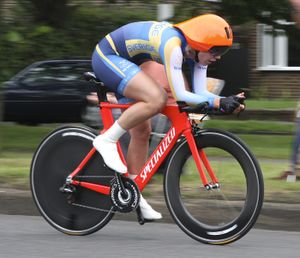
A key objective of sports biomechanics is to improve performance while reducing the incidence of injury. Noesis of the biomechanics of cycling benefits recreational, competitive and rehabilitating cyclists and physiotherapists.
The aim of biomechanics applied to cycling is to improve the cyclist's interaction with the cycle, with the aim of ensuring the comfort of the position (posture) and the efficiency (of pedaling).
In fact the practical purpose of biomechanics practical to cycling is to create products and services derived from scientific enquiry that are valid for achieving the comfort (posture) and the efficiency (pedaling)[1].[2]
Clinical Implications [edit | edit source]
The global bicycle market size was valued at USD 54.44 billion in 2020.
The number of people opting for bicycling as a course of leisure is anticipated to grow. Bicycles are a convenient form of exercise to ensure a good for you life, complimentary from obesity and other disorders.[3]
With such a large corporeality of people cycling, whether information technology be professional, recreational or for commuting this increase the run a risk of developing an injury, so it is fourth dimension we understood the biomechanics of cycling.
Points of Contact [edit | edit source]
At that place are iii points of contact in cycling. Significant iii points of the body that make contact with the bike:
- Pelvis on the saddle
- Hand on the handlebars
- Human foot on the pedal
Something to be aware of is that these areas can undergo sustained amounts of force per unit area and compression which can cause numbness, pain and weakness eg cyclist'southward palsy, cyclist's cervix[4]
Phases of Cycling/Pedalling [edit | edit source]
There are 2 chief phases of the pedal bicycle;
- Power stage: From 12 o'clock till 6, phase where all the force is mostly generated to propel the cycle forward.
- Recovery stage. From 6 back to 12 o'clock
- 12 o'clock, this is known equally Pinnacle Expressionless Centre (TDC).
- six o'clock is known as Bottom Dead Centre (BDC).
Have a look at this video (2 minutes) to learn to pedal like a pro based on leg biomechanics.
[5]
Anatomy of Cycling [edit | edit source]
The master power-producing muscles used for cycling include the quadriceps, hamstrings, and gluteals. The calf muscles, abdominals, and erector spinae, in conjunction with upper body muscles, are used for stability when riding a bike[6].
Come across the 30 2d animation beneath.
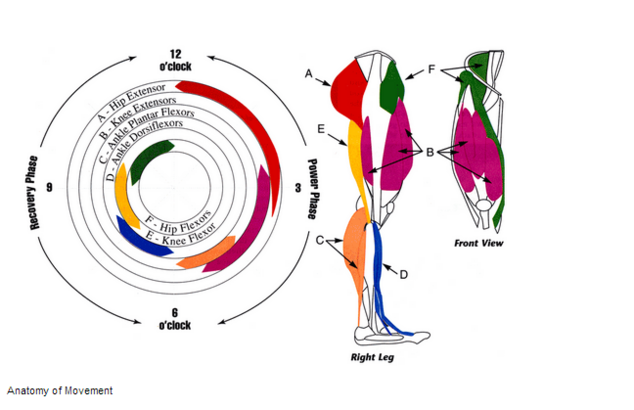
[7] If you await at the image y'all can see what muscles are working at which points during the pedal bicycle.
[8]
The Power Phase of the Cyclist's Pedal Stroke [edit | edit source]
From the pinnacle of the pedal stroke, a cyclist utilizes their hip extensors (gluteus maximus muscle) which initiates the Power Phase of the pedal stroke until point at three on a clock face up
From the bespeak of three to 5 on the clock face the knee extensors activate: vastus lateralis and vastus medialis. Many cyclists associate this point with generating the most forcefulness for their pedal stroke; this is particularly prominent while climbing out of the saddle on steep gradients.
Due to the position on the cycle, rectus femoris can become shortened leading to anterior hip hurting, likewise with rectus femoris shortening the compressive forces around the patella increase causing discomfort. See cyclist's knee. [ix]
From positions 5 to six, plantar flexion occurs, cheers to the gastrocnemius which causes the toes to point outwards[10]. The gastrocnemius and soleus's main role is to stabilise the lower leg to enable an efficient transition of the strength generated by the upper leg to the pedal.[11]
Recovery Stage of the Cyclists' Pedal Stroke [edit | edit source]
The transition from 6 o'clock support to 12 o'clock is known as the Recovery Phase. Now not all of the muscles but switch of during this phase, it merely is non as active every bit the Power Phase.
From 6 to 8, the Tibialis Inductive draws the toe upwards towards the shin. (dorsiflexion)
From 8 to 10, hamstrings (Semimembranosus, Semitendinosus and Biceps Femoris) pull the heel upwards towards the buttocks. Note: During cycling (depending on the position that is adopted past the cyclist, if on an upright wheel), the ischial tuberosities may take nearly of the load through the saddle, therefore compressing the origin of the hamstrings.
From 10 to 12, the hip flexors of the Iliacus and Psoas finish off the pedal stroke[10].
Trunk, Back and Arm [edit | edit source]
The trunk and back play an important function in stabilising the spine and maintaining posture. There are many muscles inside the back just to proper name a few: Multifidi and the quadratus lumborum are a couple of the chief stabilisers of the spine when undergoing lateral and rotational movements, such as right leg enters the ability stage whilst the left side of the spine stabilises and vice versa. The Erector Spinae muscles besides play an of import function in maintaining a stable posture whilst on the cycle.
Abdominal muscles such equally the rectus abdominus help to maintain stability as does the obliques. The obliques similarly to the dorsum muscles will assist stabilise a contralateral limb movement. As nosotros movement upwardly the spine toward the shoulders, the latissimus dorsi and trapezius muscles enable the rider to fix their upper body onto the handlebars. The upper trunk has a office in stabilising contralateral torque, then as the right leg pushes down the left arm anchors to the handle bars and pulls upward.
Similarly with the anxiety, the hands can undergo sustained amount of pressure so vascularity and nerves tin can become injured, most commonly the ulna nerve (cyclist's palsy) followed by the median nerve. [12] [13]
Joints of the Lower Limb and their Role in Cycling [edit | edit source]
- The pelvis is the showtime of the lower limb complex. The ischial tuberosities (sit down bones) are located hither are the origin role for the hamstrings.
- The hip during cycling allows for and guides hip flexion, extension and small degree of rotation.
- The knee articulation acts as a lever to the femur, equally the femur is the longest bone in the body this tin can create large amounts of torque. This is where the patella plays a vital role, as it acts as a fulcrum and enables the forcefulness from the upper leg to exist transferred to the lower leg.
- The ankle allows for dorsiflexion and plantarflexion in cycling.
- The foot is where the strength that is generated from the lower limb circuitous is transferred to the pedal. Irregular amounts of force or compression running through the foot tin can result in neural pain and tissue damage from pinch. [xiv] [15]
Bike Fit [edit | edit source]
Correct positioning is critical for successful operation and injury prevention[2]. A correctly fitted bike can prevent many of the overuse injuries that occur from faulty biomechanics (poor position). Information technology also means you lot can get the more comfort and tin can ride better and faster. The right position varies from person to person, depending on factors like age, mode of riding, and concrete attributes similar flexibility and anatomical variants.
The video below gives a basic Bike Fit didactics. The key elements outlined being saddle meridian, saddle layback and handlebar reach.
[16]
Jaw Clenching [edit | edit source]
The jaw clenching facial expression can be considered an important factor for estimating the intensity of effort.
- Frowning and jaw clenching muscle action reflects the perception of effort during incremental workload cycling.
- EMG action of the masseter muscle is strongly and positively correlated with RPE, HR and lower limb EMG activity during incremental workload cycling.[17]
References [edit | edit source]
- ↑ Velo system What is biomechanics applied to cycling or bicycle plumbing equipment? Available:https://velosystem.com/ciclista/cycling-performance/biomechanics-and-bike-fitting/?lang=en (accessed 18.12.2021)
- ↑ two.0 ii.ane Sports performance Cycling biomechanics Available:https://www.sportsperformancebulletin.com/endurance-training/techniques/cycling-biomechanics/ (accessed 17.12.2021)
- ↑ Thousand view inquiry Bicycle Market Size, Share & Trends Analysis Written report By Production (Mountain, Hybrid, Route), Past Technology (Electric, Conventional), Past Finish User (Men, Women, Kids), By Region, And Segment Forecasts, 2021 - 2028 Available:https://www.grandviewresearch.com/industry-assay/wheel-market (accessed 17.12.2021)
- ↑ Burt P. Bike Fit. Bloomsbury: London. 2014
- ↑ Pioneercyclo.How to pedal like a Pro?. Bachelor from https://world wide web.youtube.com/watch?time_continue=2&v=Bg4q-54u9Bg&characteristic=emb_logo
- ↑ Grooming road Muscles used for cycling Available:https://world wide web.trainerroad.com/blog/muscles-used-for-cycling-and-how-to-train-them/ (accessed 17.12.2021)
- ↑ Pioneercyclo Which Muscles Are Used When Riding a Wheel?Available from:https://www.youtube.com/watch?five=MqLHuwxB5-c (last accessed 17.12.2021)
- ↑ Cycle Flavor is Here in Vancouver, How is your Pedal Stoke? http://www.mypersonaltrainervancouver.com/wheel-season-is-hither-in-vancouver-how-is-your-pedal-stroke/ (accessed 27 May 2016)
- ↑ CA Wilber, C1 Kingdom of the netherlands, RE Madison, 5F Loy. An Epidemiological Analysis of Overuse Injuries Amongst Recreational Cyclists. Int. J. Sports Med. 1995;xvi(3): 201 -206.
- ↑ 10.0 10.ane Skyaboveus Muscles of cycling Available:https://skyaboveus.com/cycling/Muscles-groups-used-while-cycling (accessed 17.12.2021)
- ↑ Burt P. Bike Fit. Bloomsbury: London. 2014
- ↑ Burt P. Bike Fit. Bloomsbury: London. 2014
- ↑ MC Ashe, GC Scroop, PI Frisken, CA Amery, MA Wilkins, KM Khan. Body position affects performance in untrained cyclists. Br J Sports Med. 2003;37:441–444
- ↑ Burt P. Bike Fit. Bloomsbury: London. 2014
- ↑ Wozniak CA. Cycling Biomechanics: A literature Review. Periodical of Sports Concrete Therapy. 1991;14(3):106-113
- ↑ Global Bike Network. How to perform a basic bike fit. Bachelor from: https://www.youtube.com/watch?v=1VYhyppWTDc [ last accessed 19.8.2019]
- ↑ Huang DH, Chou SW, Chen YL, Chiou WK. Frowning and jaw clenching muscle activity reflects the perception of attempt during incremental workload cycling. Journal of sports science & medicine. 2014 Dec;xiii(4):921. Available:https://www.ncbi.nlm.nih.gov/pmc/articles/PMC4234963/ (accessed 17.12.2021)
Source: https://www.physio-pedia.com/Cycling_Biomechanics
0 Response to "Are You Back Peddling Again Gif?"
Post a Comment