Toad Mario Sprite Toad Mario Sprite Pixel Art Original
Mario Sprites
So, what is a sprite?
In computer graphics, a sprite (as well known by other names; see Synonyms below) is a two-dimensional image or blitheness that is integrated into a larger scene.
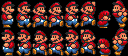
Sprites were originally invented every bit a method of quickly compositing several images together in two-dimensional video games using special hardware. As calculator performance improved, this optimization became unnecessary and the term evolved to refer specifically to the two dimensional images themselves that were integrated into a scene. That is, figures generated by either custom hardware or by software lonely were all referred to as sprites. As 3-dimensional graphics became more prevalent, the term was used to describe a technique whereby flat images are seamlessly integrated into complicated iii-dimensional scenes.

More ofttimes sprite at present refers to a partially transparent ii dimensional blitheness that is mapped onto a special plane in a 3 dimensional scene. Unlike a texture map, the sprite plane is ever perpendicular to the centrality emanating from the photographic camera. The image can be scaled to simulate perspective, it can exist rotated two dimensionally, it tin overlap other objects and be occluded, but it tin only exist viewed from the same angle. This rendering method is as well referred to as billboarding.
Sprites create an constructive illusion when:
- the image inside the sprite already depicts a three dimensional object
- the animation is constantly changing or depicts rotation
- the sprite exists merely for a short period of fourth dimension
- the depicted object has a similar appearance from many common viewing angles (such equally something spherical)
- the viewer accepts that the depicted object only has i perspective. (such as small plants or leaves)
When the illusion works viewers volition not observe that the sprite is flat and always faces them. Often sprites are used to describe phenomena such as burn, smoke, small objects, small plants (like blades of grass), or special symbols (like "1-Up"). The sprite illusion can exist exposed in video games past chop-chop changing the position of the camera while keeping the sprite in the center of the view.
Sprites have also occasionally been used as a special-effects tool in movies. I such instance is the fire animate Balrog in The Lord of the Rings: The Fellowship of the Band; the effects designers utilized sprites to simulate fire emanating from the surface of the demon. Small bursts of fire were filmed in front of a black background and fabricated transparent using a luma key. Many bursts were then attached to the surface of the animated Balrog model and mixed with imitation smoke and estrus waves to create the illusion of a monster made from fire.
The term "sprite" is often confused with depression resolution 2nd graphics fatigued on a computer, also known equally pixel art. However, in addition to pixel fine art, sprites can be created from prerendered CGI, dynamic 3D graphics, vector art, and even text. Likewise, pixel art is created for many purposes other than as a sprite, such as video game backgrounds, textures, icons, websites, display art, comics, and t-shirts. With the advocacy in computer graphics and improved ability and resolution, bodily pixel art sprites are becoming increasingly infrequent outside of handheld game systems and cell phones.
Billboarding
Billboarding is one term used to describe the use of sprites in a 3D surround. In the same mode that a billboard is positioned to face drivers on a highway, the 3D sprite always faces the photographic camera.
Rationale
In that location is both a performance advantage and an aesthetic reward to using billboarding. Most 3D rendering engines tin process "3D sprites" much faster than other types of 3D objects. So it is possible to gain an overall performance improvement by substituting sprites for some objects that might ordinarily exist modeled using texture mapped polygons. Aesthetically sprites might be desirable because polygons might never be able to realistically reproduce phenomena such as fire. Sprite images of burn might provide a more attractive illusion.
Alternative terms
- 3D Sprite is a term ofttimes used to refer to sprites that are essentially texture mapped 3D facets that e'er have their surface normal facing into the photographic camera.
- Z-Sprite is a term often used for 3D environments that contain simply sprites. The Z-parameter provides a scaling issue that creates an illusion of depth. For example in adventure games such as King's Quest VI where the photographic camera never moves, normal 2d sprites might suffice, only Z-sprites provide an extra impact.
- Impostor is a term used instead of billboard if the billboard is meant to subtly supplant a real 3D object.

Hardware sprites
In early video gaming, sprites were a method of integrating unrelated bitmaps so that they announced to be part of a single bitmap on a screen.
The Blitter is a hardware implentation of the Painter's algorithm. For each frame the sprites are commencement fleck blited (short for "bit cake transfer") into the fast, large, double, and costly frame buffer and then the frame buffer is sent to the screen. The Blitter was renamed to graphics accelerators as more complicated rendering algorithms are used. The Blitter has a high initial cost for simple scenes.
The Sprite Engine is a hardware implementation of Scanline rendering. For each scanline the appropriate scanlines of the sprites are first copied (the number of texels is express past the memory bandwidth and the length of the horizontal retrace) into very fast, small, multiple (limiting the # of sprites on a line), and costly caches (the size of which limit the horizontal width) and equally the pixels are sent to the screen, these caches are combined with each other and the background. Information technology may exist larger than the screen and is usually tiled, where the tile map is buried, simply the tile gear up is not. For every pixel, every sprite unit signals its presence onto its line on a bus, so every other unit tin notice a standoff with it. Some sprite engines can automatically reload their "sprite units" from a display list. The Sprite Engine has synergy with the palette. To save registers, the superlative of the sprite, the location of the texture, and the zoom factors are oftentimes limited. On systems were the word size is the aforementioned equally the texel in that location is no penality for doing unaligned reads needed for rotation. This leads to the limitations of the known implementations.
Many third party graphics cards offered sprite capabilities. Sprite Engines often scale desperately, starting to flicker equally the number of sprites increases above the number of sprite units, or uses more and more than silicon as the designer of the flake implements more than units and bigger caches.
Background
No sprite engine was implemented which would not cache the sprites texels, merely use a FIFO at the pixel-output instead. This would permit sprites of arbitrary width. And then while blitter based hardware uses a unified model for foreground and background and a stock-still apartment frame-buffer, sprites demand a special background engine. It has to provide scrolling backgrounds for tile-based games and pseudo-3D ( mode 7) backgrounds.
A similar discrimination is known from software rendering. A technique chosen "dirty rectangles" is used to redraw but those parts that have changed since the last repainted and a scrolling frame buffer is used. On more powerful CPUs the whole frame-buffer is flat and redrawn completely.
History
In the mid-1970s, Texas Instruments devised the first video/graphics processors capable of generating sprite graphics. The TMS 9918 video processors were commencement used in the 1979 TI-99/4.
The Atari 400 and Atari 800 systems were among the first PCs capable of generating sprite graphics, which Atari referred to every bit player/missile graphics (PMGs).
During nearly of the 1980s, hardware speed was in the low, single-digit megahertz and memory was measured in mere kilobytes. Abreast CISC processors, all fries are hardwired. Sprites are rare in most video hardware today.
The fundamental processor can instruct the external chips to fetch source images and integrate them into the main screen using direct memory access channels. Calling upward external hardware, instead of using the processor alone, greatly improved graphics operation. Because the processor is not occupied by the simple job of transferring data from one place to another, software can run faster; and because the hardware provided sure innate abilities, programs that employ CISC or BIOS were too smaller.
Split locations in memory were used to concur the main display and the sprites.
Some sprite engines could simply store a small amount of positions in their registers and the unchallenged CPU was programmed to update them several times per frame. Software blitting was complicated past some very strange addressing modes into video ram.
Application
Sprites are typically used for characters and other moving objects in video games. They have also been used for mouse pointers and for writing letters to the screen.
For on-screen moving objects larger than i sprite'southward extent, sprites may sometimes exist scaled and/or combined.
Synonyms
Sprites have been known by several alternative names:
- Player-Missile Graphics was used on the Atari 400/800 and Early Atari Coin Op games to refer to hardware-generated sprites. The term reflected the usage for both characters ("players") and other objects ("missiles"). They had restricted horizontal resolution (8 or 2 pixels, albeit with scalability, and a potential 192 lines of vertical resolution), limiting their use somewhat.
- Movable Object Cake , or MOB was used in MOS Technology's graphics chip literature (information sheets, etc). Notwithstanding, Commodore, the main user of MOS chips and the owner of MOS for near of the chip maker's lifetime, applied the common term "sprite".
- On the Nintendo Amusement System, Super Nintendo Entertainment System, and Game Boy, sprites were referred to equally OBJ s (short for "objects"), and the region of RAM used to store sprite attributes and coordinates was known every bit OAM (Object Attribute Retentiveness). This still applies today on the Game Male child Advance and Nintendo DS handheld systems.
- BOB's or 'Blitter Objects', popular proper noun for graphics objects drawn with the dedicated graphics blitter in the Amiga series of computers, which was bachelor in add-on to its truthful hardware sprites.
- Software sprites were used to refer to subroutines that used flake blitting to accomplish the same goal on systems such as the Atari ST and the Apple tree II whose graphics hardware had no sprite capability.
- The estimator programming language Dark Basic used the term Bob (for "blitter object") to refer to its software-sprite functions, earlier switching to the more conventionally-used "sprite" term.
Move to 3D
Prior to the popularizing of true 3D graphics in the late 1990s, many 2nd games attempted to immitate the look of three-dimensionality with a variety of sprite product methods. These included...
- Live Actors - The filmed performances of live-actors were sometimes used for creating sprites, most famously in the instance of Mortal Kombat which added a relative chemical element of realism to a gruesome fighting game. The method was used in a number of other fighting games, mostly in the mid 90s.
- Claymation or the use of posable models which were used for characters that could not be potrayed by actors. Famous early examples include Goro of Mortal Kombat and Arachnotron from Doom. Used to a greater extent in games similar Dirt Fighter.
- Pre-rendered CGI models - Showtime seen in Nintendo's Donkey Kong Country and later used to a keen extent in PC Existent-time Strategy and RPG games prior to the motility to truthful 3D. Since computers of the day could not run circuitous 3D graphics, footage of pre-rendered three-dimensional character models were often used which created (a relative) illusion of 3D.
Sprite culture
"Spriters" generally employ them to become sprite comic artists, for the purpose of creating a comic. Information technology has been connected by Macromedia Flash animators who create sprite cartoons. In these communities, spriting has been made into minor sections; recoloring, edits, customs, etc. Sprites can be alternated by using techniques such equally the ones above. By doing this, Spriters can create their very ain "Sprite character" to use in "Sprite sheets" to evidence that the sheet was made by that spriter only the spriter must put a "sprite tag" on the canvass maxim something like "Please do not steal" or "give credit" or "If you lot wish to put this on your site, do not remove this tag",etc. Sprites can be edited from any game where sprites are available. Making pictures with sprites is called a "Hoax" which is the sprites in a grouping or doing sure actions only a "Hoax" is not a true prototype from a game.
Dwelling house
Source: https://www.mariomayhem.com/downloads/sprites/
0 Response to "Toad Mario Sprite Toad Mario Sprite Pixel Art Original"
Post a Comment