What Was the First State to Legalize Weed for Recreational Use
More than half of U.s. adults, over 128 million people, have tried marijuana, despite it beingness an illegal drug under federal law. [43] Nearly 600,000 Americans are arrested for marijuana possession annually – more than than one person per infinitesimal. [82] Public support for legalizing marijuana went from 12% in 1969 to 66% today. [249] Recreational marijuana, as well known as adult-use marijuana, was starting time legalized in Colorado and Washington in 2012.

Proponents of legalizing recreational marijuana say it volition add billions to the economic system, create hundreds of thousands of jobs, free up deficient police force resources, and stop the huge racial disparities in marijuana enforcement. They contend that regulating marijuana will lower street crime, disrupt the drug cartels, and make marijuana use safer through required testing, labeling, and kid-proof packaging. They say marijuana is a relatively harmless herb, and that adults should have a correct to use it if they wish.
Opponents of legalizing recreational marijuana say it will increase teen use and atomic number 82 to more medical emergencies including traffic deaths from driving while high. They contend that revenue from legalization falls far short of the costs in increased hospital visits, addiction treatment, environmental damage, law-breaking, workplace accidents, and lost productivity. They say that marijuana use harms the user physically and mentally, and that its utilise should be strongly discouraged, non legalized.
Terminology
Pot. Weed. Ganja. Mary Jane. In that location are more than a g slang terms in the English language to refer to marijuana. [88] A 1943 article in Time magazine chosen it muggles, mooter, and bambalacha, and referred to marijuana cigarettes equally goof-butts and giggle-smokes. [ninety] According to the Oxford English Dictionary, apply of the word "marijuana" (as well written every bit "marihuana" in older references) came to popularity in the United states of america in the 1930s as an alternative to the more than familiar terms "cannabis" and "hemp." [89]
Cannabis, the scientific name for marijuana, is a plant that has iii species (or strains): cannabis indica, cannabis sativa, and the less common cannabis ruderalis. [245] Marijuana and hemp are both cannabis plants, but marijuana contains higher levels of THC (delta-9-tetrahydrocannabinol), the principal psychoactive ingredient that causes people to go high. [33] Hemp tin can exist cultivated for industrial uses such as rope and burlap fabric, or for a low-THC, non-psychoactive, medicinal production. [123][245] This website uses the words "cannabis" and "marijuana" interchangeably, and the words "recreational" and "adult-use" interchangeably.
Marijuana legalization refers to the practice of allowing and regulating the production, distribution, sale, and possession of cannabis and then that marijuana utilize within the established rules is no longer a crime. [33] There are different models of legalization, ranging from assuasive people to grow their ain marijuana to nonprofit co-ops to for-profit commercialization with retail sales. [143][150]
Early History of Cannabis in the United States
Source: Library of Congress (accessed Aug. 31, 2011)
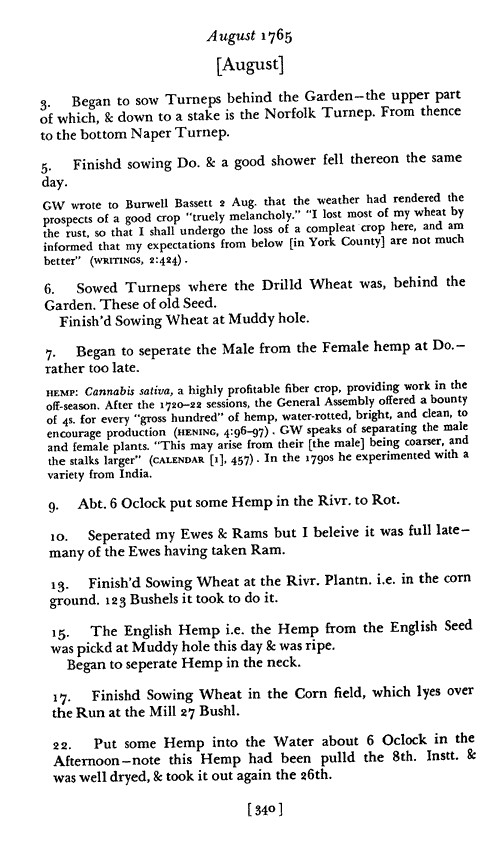
While references to marijuana equally a popular medicine are found in Chinese writings dating back to 2900 BC, the marijuana plant made its arrival in North America in 1611 thanks to the Jamestown settlers. [99][121] Early colonists were required to grow hemp. [177] George Washington and Thomas Jefferson grew hemp for clothing, rope, and fishing nets in the 1770s. [182][183] By the 1800s, doctors were using cannabis extracts for various ailments, and marijuana was listed in the United States Pharmacopeia equally a handling for opiate addiction, leprosy, cholera, and more. [246] In the mid-1800s, hemp was the third-largest crop in the Usa, behind cotton and tobacco. [178]
Tendency towards Outlawing Marijuana, Early 1900s
At the get-go of the 20th century, drugs were largely unregulated: beverages such as Coca-Cola contained cocaine, heroin was sold equally an over-the-counter medicine, and cannabis was available in tinctures. [189][190] The 1906 Pure Food and Drug Deed, which specifically mentioned cannabis indica, kicked off drug regulation in the U.s.a. by requiring ingredient labeling in drugs and food. [191] The 1914 Harrison Narcotics Human action, which regulated and taxed opiates and cocaine, was before long followed by the 1918 prohibition of alcohol. [192]
Mexican immigrants entered the United States in record numbers following the 1910 Mexican Revolution. They reportedly introduced Americans to smoking marijuana for recreational purposes. [185][186] Effectually the same time, sailors and Westward Indian immigrants brought marijuana from the Caribbean into North America via New Orleans. [179] In the 1920s and 1930s, recreational cannabis use became associated with the jazz music, and the famous trumpet player Louis Armstrong was an early advocate for marijuana. [187][188]
Source: "REEFER MADNESS!," posterwire.com (accessed Feb. ix, 2018)
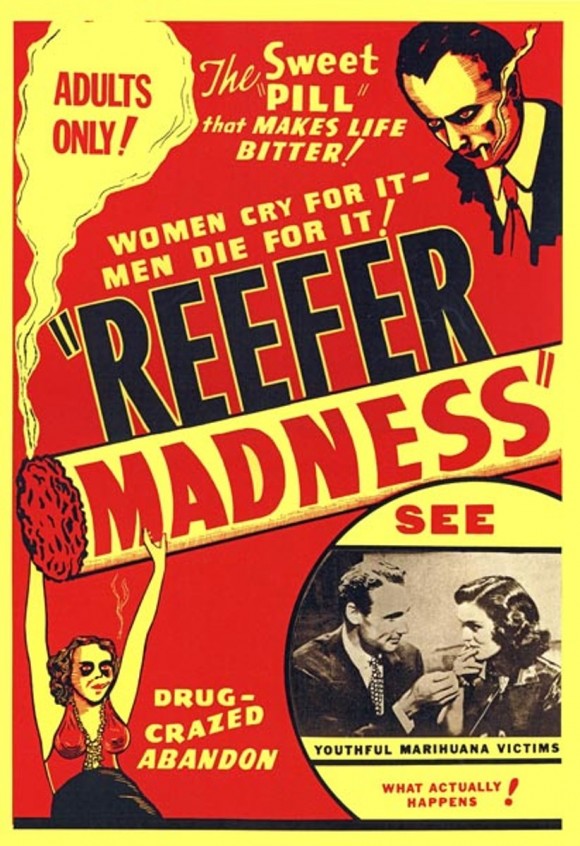
The rise of the discussion "marijuana" (from the Spanish "marihuana") as a replacement for the then-familiar terms cannabis and hemp is often attributed to prohibitionists, like Harry Anslinger, the first commissioner of the Federal Bureau of Narcotics, [193] who wanted to acquaintance cannabis with demeaning or racist stereotypes most Mexican immigrants and other minorities. [169][155][179][184][198][163][175] Following the 1933 repeal of alcohol prohibition, Anslinger focused on fighting marijuana, which had already been banned in 29 states by 1931. [169][194] He tried to plow public opinion against cannabis with quotes such equally: "There are 100,000 full marijuana smokers in the U.Due south., and nigh are Negroes, Hispanics, Filipinos and entertainers. Their Satanic music, jazz and swing result from marijuana use. This marijuana causes white women to seek sexual relations with Negroes, entertainers and any others." [195] His efforts were aided by a 1936 anti-marijuana propaganda film, Reefer Madness, likewise as by newspaper publisher William Randolph Hearst, who famously printed articles designed to foster fear of the drug. [196][197][198]
1937, the Year Marijuana Became Illegal
Source: hempology.org (accessed Feb. 9, 2018)
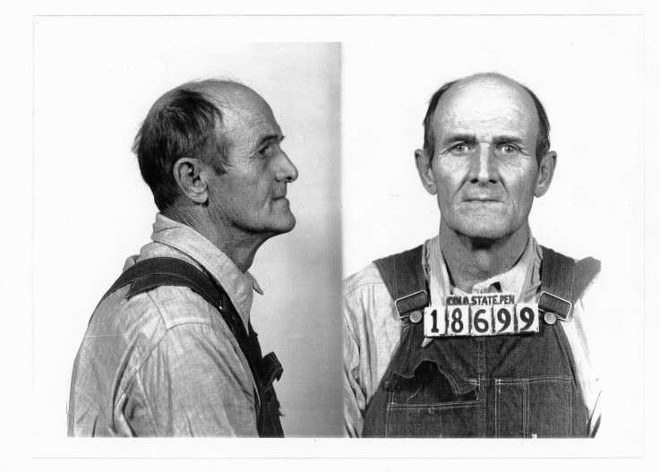
The 1937 Marihuana Tax Act finer outlawed cannabis apply in the United States by adding strict regulations and prohibitive taxes that made marijuana likewise expensive to buy or sell legally. [199][194][178] It became a federal crime to possess marijuana, including hemp, without having the required tax stamps. [201][202] Importers and manufacturers of marijuana were required to pay an almanac taxation of $24 (more than $400 in 2018 dollars). [204] Transfers of marijuana to non-registered people were bailiwick to a taxation of upwards to $100 per ounce (more than than $1,700 in 2018 dollars). [200] Legal transfers of marijuana involved special lodge forms and strict record keeping. Violations of the Human action were subject to fines of up to $2,000 ($34,260 in 2018 dollars) and five years in prison. [203] In October 1937, Samuel Caldwell became the starting time marijuana seller convicted under The states federal law and he was sentenced to four years of hard labor at Leavenworth Penitentiary. [205]
Marijuana from 1938 through the Sixties
In 1938, New York City Mayor Fiorella LaGuardia directed the New York Academy of Medicine to research marijuana. Their report became 1 of the kickoff comprehensive reviews of the drug's touch. [206][207] The 1944 LaGuardia written report ended that "The practice of smoking marihuana does not lead to addiction… Marihuana is not the determining gene in the commission of major crimes… The publicity concerning the catastrophic furnishings of marihuana smoking in New York City is unfounded." [208] The findings infuriated Commissioner Anslinger, who denounced the study as a "government-printed invitation to youth and adults – above all teenagers – to become ahead and fume all the reefers they feel like." The written report did not alter federal marijuana policy. [209][210]
Marijuana remained popular with musicians, artists, writers, and others throughout the 1940s and 1950s. Marijuana use became more than common on college campuses in the 1960s aslope the ascent of the hippie counterculture and Vietnam state of war protests. [33] Information technology also became more widespread among upper-middle class white Americans. [194][211][177] Efforts to re-legalize marijuana grew stronger. The 1965 arrest of Timothy Leary, a Harvard psychologist who experimented with hallucinogens and became a counterculture icon, led to the Marihuana Tax Act being overruled by the Supreme Courtroom in 1969. The courtroom agreed with Leary's argument that the police violated his fifth amendment correct against self-incrimination because he wouldn't have been able to follow the law's registration requirements without albeit to breaking country marijuana bans. [209]
President Nixon and the 1970 Controlled Substances Act
In 1970, President Nixon signed the bill that makes marijuana illegal under federal law to this day. [209] As a political party to the 1961 Single Convention Treaty, the Usa was required to limit marijuana use "exclusively to medical and scientific purposes." That obligation was implemented with the 1970 Controlled Substance Human activity (CSA). [139][212] Under the CSA, drugs were put into one of 5 categories based on their medical use and potential for abuse. [177] Marijuana was placed in the nearly restrictive category, Schedule I, which was designated for "drugs with no currently accustomed medical employ and a high potential for abuse," forth with heroin and LSD. Drugs such equally cocaine and methamphetamine were placed in the less restrictive Schedule 2.[213]
Marijuana's placement in Schedule I was supposed to be temporary pending a federal review by the newly formed National Committee on Marihuana and Drug Policy (more commonly known as the Shafer Commission). [169][225][214] The commission's 1972 report ended that "neither the marihuana user nor the drug itself can exist said to constitute a danger to public safety," and recommended that marijuana possession for personal use no longer be considered a criminal criminal offense. [224] President Nixon'southward response was, "[R]eading it did not change my heed. I oppose the legalization of marijuana." [226] Regardless of the commission'south recommendation, marijuana was left in Schedule I and remains there today.
NORML, Holland, and Decriminalization
The same year that the CSA was enacted, 1970, the National Organization for the Reform of Marijuana Laws (NORML) was founded to abet for the end of marijuana prohibition. Between 1973 and 1981, the system successfully fought to get minor marijuana offenses decriminalized in xi states and lower penalties for marijuana possession in other states. [217][209]
A policy of decriminalization was adopted in the netherlands in 1976 for what it accounted "soft drugs," which included cannabis. Under the Dutch Opium Act, possession of less than 5 grams of marijuana is presumed to be for personal apply and is therefore not prosecuted. The police force also allows for coffee shops where people are able to buy and use cannabis. [219] Decriminalization of marijuana means people don't get arrested for possessing small amounts of marijuana, and may be required to pay a civil fine instead of facing criminal charges. This is a pace towards loosening marijuana prohibition, just is non considered to be legalization. [218] Today, some marijuana legalization opponents advocate for decriminalization instead. [216]
Marijuana at the Stop of the 20th Century
Source: Timeline, "Watch: Ronald Reagan and His 'War on Drugs,'" timeline.com, June 26, 2017
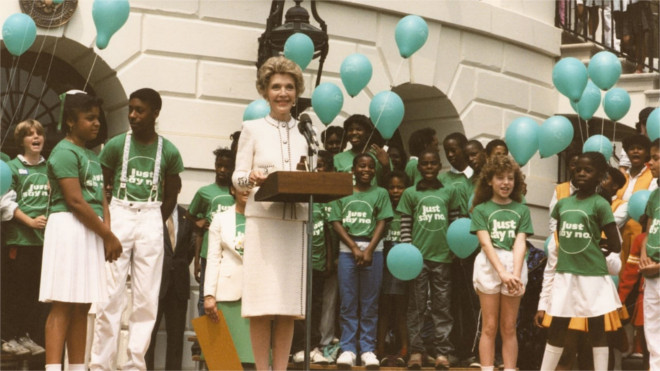
In the 1980s, a rise in parent groups concerned about the increase in teen drug use coincided with the ballot of President Ronald Reagan, who in 1982 alleged a "war on drugs," echoing the phrase popularized by Nixon. [221][220] First Lady Nancy Reagan spearheaded the "Just Say No" campaign aimed at convincing kids not to use drugs and seeking to overturn lenient drug laws. [222][169] Parent lobbying groups such as the National Federation of Parents for Drug-Gratuitous Youth, now known as National Family Partnership, established a presence in Washington, DC, to advocate for anti-drug legislation. [177] Throughout the 1980s, federal and land criminal penalties for marijuana became stricter and mandatory-minimum sentences were established. [223]
Marijuana arrests increased dramatically in the 1990s, more than than doubling betwixt 1990 and 2002, from 327,000 to 697,000 annually. In New York City, marijuana arrests jumped 882% in that period. [227] A report from the Sentencing Project stated, "Our analysis indicates that the 'war on drugs' in the 1990s was, essentially, a 'war on marijuana.'" [227] At the same time, public opinion was shifting in favor of medical marijuana. In 1996, California became the commencement state to legalize marijuana for medical purposes when voters passed Proposition 215. By the terminate of 2000, eight states had legalized medical marijuana. By 2017, 29 states and Washington, DC, had legalized it.
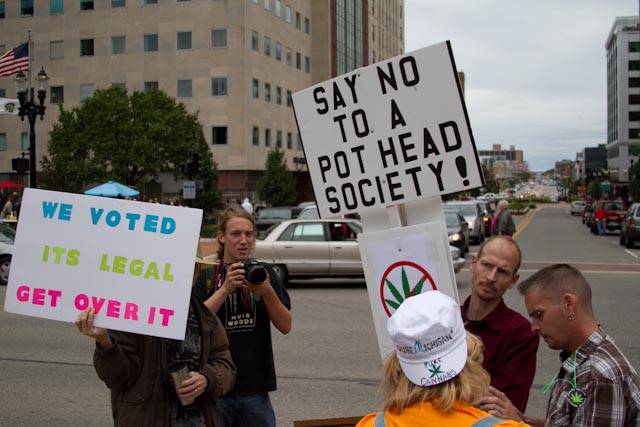
Source: William Breathes, "Fierce Assail at Marijuana Rally Ignored by Police," tokeofthetown.com, Sep. 13, 2011
Trend towards Recreational Marijuana Legalization
Although a 2010 California proffer to legalize adult-use marijuana failed, measures to legalize recreational marijuana were on the ballots in three states ii years subsequently, in Nov. 2012. [231][232] While Oregon voters turned down the measure, Colorado and Washington became the start two US states to legalize developed-use marijuana. [228][229][230] Support for legalizing recreational marijuana increased as more than people, including many who never tried marijuana, believed that marijuana use was not equally unsafe as the authorities reported and not a gateway to using hard drugs. [180][215] People were likewise becoming unhappy with the sheer price of enforcing marijuana laws and the growing prison house populations, especially among minority populations. Plus, more people were exposed to marijuana and "out-in-the-open" marijuana users cheers to liberalized marijuana policies in medical marijuana states. Younger generations were increasingly more likely to back up legalization. [180][215] Marijuana, however, remained an illegal Schedule I drug under federal law.
Concerns virtually how the federal government would react to the new laws were lessened somewhat with a 2013 advice from President Obama's Justice Section known every bit the Cole memo. Deputy Attorney General James M. Cole stated that and then long equally states had good regulations, then the federal authorities would hold off on challenging marijuana legalization. [234] Marijuana retail stores opened in Colorado on Jan. one, 2014, allowing adults 21 and older to purchase cannabis that is taxed and regulated under land police force. [233] Washington's marijuana shops opened on July viii, 2014. [209]
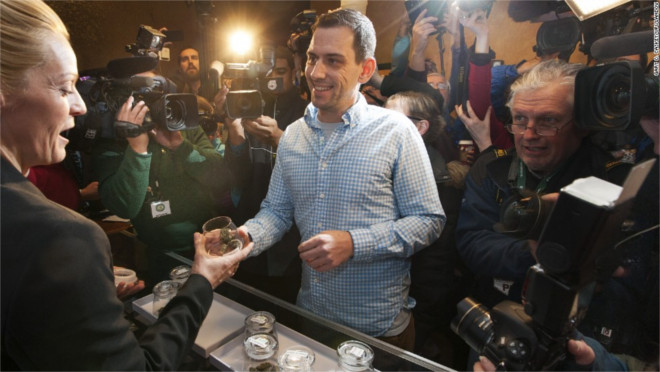
Source: Michael Martinez, "ten Things to Know about Nation's Get-go Recreational Marijuana Shops in Colorado," cnn.com, Jan. 1, 2014
In November. 2014, Oregon and Alaska passed recreational marijuana election measures following the same model as Washington and Colorado, which is a for-profit commercial marijuana manufacture that allows retail sales. [236][237][143] That same year, Washington, DC, voters canonical an initiative that allowed home cultivation and personal possession but not retail sales. [235][238] In the Nov. 2016 election, California, Maine, Massachusetts, and Nevada all passed legal recreational ballot measures that follow the commercialization model, although retail sales in Maine were put on hold by the land legislature. [239][241][240][242] In Jan. 2018, Vermont became the first state to legalize marijuana by fashion of the state legislature rather than past ballot initiative, enacting a law that did not allow for retail sales. [243][244]
The election of President Trump in 2016 and his appointment of Jeff Sessions equally US Chaser General in 2017 raised new questions about whether the federal government would crack down on states that were legalizing adult-use marijuana. On Jan. 4, 2018, Sessions issued a memo that undid the easily-off policy enacted by President Obama's Justice Section, and instructed federal prosecutors to determine for themselves when to prosecute marijuana activities. [176][181]
On June 7, 2018, Senator Elizabeth Warren (D-MA) and Senator Cory Gardner (R-CO) introduced the Strengthening the 10th Amendment Through Entrusting States (STATES) Act, which they say "ensures that each State has the right to determine for itself the all-time approach to marijuana within its borders." [247] Asked about the legislation, President Trump said, "I support Senator Gardner. I know exactly what he's doing. Nosotros're looking at it. Just I probably volition cease up supporting that, yep." [248]
On Oct. 17, 2018, Canada'south Cannabis Human activity took upshot, allowing adults age 18 and over to possess, share, buy, and grow marijuana. [250] Canada was the second country to legalize marijuana, following Uruguay'due south 2013 legalization. [251]
President Trump signed the Agronomics Improvement Act of 2018 (known as the Farm Neb) into police force on Dec. 20, 2018. This constabulary legalized industrial hemp that contains less than 0.three% THC by removing it from the Controlled Substances Act. Cannabidiol (CBD) and tetrahydrocannabinol (THC) remain federally illegal to include in food or wellness products without FDA approval, even if they were derived from hemp. [253]
Four states legalized recreational marijuana in the Nov. 2020 election: Arizona, Montana, New Jersey, and South Dakota. Ii states too legalized medical marijuana, Mississippi and South Dakota, with the latter beingness the first state to legalize both medical and recreational marijuana in the same election (though a court battle, ending on Nov. 24, 2021, would rule recreational marijuana yet illegal in the state because of the way the ballot initiative was written). Taken as a whole, all vi marijuana measures on the ballot in the Nov. 2020 election passed. Steve Hawkins, JD, Executive Manager of the Marijuana Policy Project, stated, "With the passage of these initiatives, one-third of the population now lives in jurisdictions that have legalized cannabis for developed use, and 70% of all states have embraced cannabis for medical use." [256] [265]
On December. iv, 2020, the The states Business firm passed a marijuana decriminalization pecker (228-164) that would remove marijuana from the Controlled Substances Human activity, likewise as add a 5% tax on marijuana to aid people almost affected by marijuana criminalization and to fund community and small business grants. Though the bill did not pass the Republican-controlled Senate, it was the first time either bedroom has passed such an human activity. The legislation was led by Representative Jerry Nadler (D-NY) with Senator and Vice-President elect Kamala Harris (D-CA). [257]
In a largely partisan vote, the US Business firm of Representatives voted 220 to 204 to decriminalize marijuana on Apr. 1, 2022. Tom McClintock (R-CA), Brian Mast (R-FL), and Matt Gaetz (R-FL) crossed party lines to back up the bill, while Henry Cuellar (D-TX) and Chris Pappas (D-NH) voted confronting decriminalization. If passed by the Senate, the pecker "will prevent federal agencies from denying federal workers security clearances for cannabis use, and will let the Veterans' Administration to recommend medical marijuana to veterans living with posttraumatic stress disorder, plus gains revenue by authorizing a sales revenue enhancement on marijuana sales" and "expunge… the record of people convicted of not-trigger-happy cannabis offenses." However, neither the Business firm bill nor a similar bill in the Senate are expected to garner enough Republican votes to be passed. [267]
International Laws
Every bit of Dec. 15, 2021, 3 countries take fully legalized recreational marijuana: Malta (2021), Canada (2018), and Uruguay (2013). Luxembourg plans to legalize according to a statement released on Oct. 22, 2021. In a handful of other countries, including but not limited to Georgia, United mexican states, and South Africa, adult-employ marijuana is decriminalized, meaning possession and consumption of marijuana are legal, but selling or buying is illegal. Some countries with decriminalized marijuana allow tillage, others practise non. [258] [259] [260] [261] [262] [263] [264][266]
Source: https://marijuana.procon.org/history-of-recreational-marijuana/
0 Response to "What Was the First State to Legalize Weed for Recreational Use"
Post a Comment